
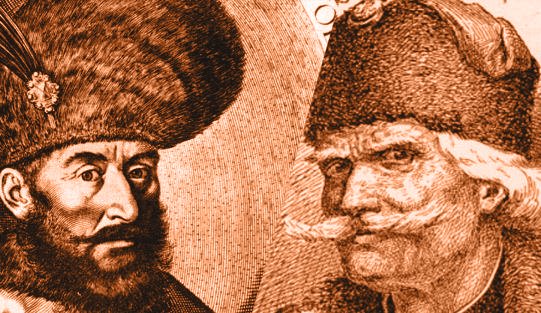
Baba Novac, general celebru al Mihai Viteazul

Baba Novac, general celebru al Mihai Viteazul

Baba Novac was a famous general under the rule of Mihai Viteazul. It seems that Baba Novac entered Mihai Viteazul’s service at the beginning of his reign, most likely after the battle of Călugăreni in 1595. In the spring of 1596, he led his band of haiducs, crossing the Danube and advancing to the Balkan Mountains, where he routed Hasan Pasha and his army.

An Transylvanian chronicler has detailed information about this campaign, which elevated Baba Novac to one of the most esteemed men in the Romanian voivode’s court: „Mihai Vodă sent him once with an army across the Danube. Baba Novac set out with seven hundred men and burned the Vratsa castle, two days’ journey from the Danube. At that time, the Turks gathered on this side of the Danube to cut off his retreat. Baba Novac, not daring to return the same way he came (and being a good guide), led his entire army to Mount Barkoncza, which was beyond Vratsa, near Mount Novac (the Balkans). He wandered around here with his army until he reached Sofia. Finally, after many detours, he returned to the Danube at the old Florentine castle, downstream from Orșova, not far from Vidin. Here, he fought against the Florentine Turks and captured many ships belonging to the castle. With these ships, he crossed the Danube with his seven hundred soldiers and returned to Wallachia with few losses – after so many wanderings. Only eight of his soldiers perished. He brought back many slaves and livestock. Since then, he was highly esteemed by Mihai Vodă.”

Baba Novac’s army consisted mostly of haiducs, armed with spears or other weapons, most of whom were of Serbian origin. The haiducs represented a distinct military unit in Mihai Viteazul’s army, alongside dorobanți and cătane, which together formed a mercenary army, in addition to the small native army. It is a mistake to see Baba Novac, the commander of the „haiducs” at the end of the 16th century – when Baba Novac lived – as a haiduc from the beginning of the 19th century, when, for example, Iancu Jianu lived.

Baba Novac would always be by his great lord’s side, in all his victorious battles, and later covering his retreat in those battles that led to his downfall. In the brilliant victory at Șelimbăr (October 28, 1599), which brought the whole of Transylvania under Mihai’s rule, Baba Novac played a major role. Coming through the Turnu Roșu Pass, while the voivode crossed into Transylvania through the Buzău Pass and headed towards Sibiu through Brașov and Făgăraș, he joined his lord in front of the village of Șelimbăr, forming the left wing of the Romanian army. Impetuous, as it seems, he did not want to wait for the outcome of the diplomatic negotiations – initiated between the envoy of Cardinal Andrei Báthory, Bishop Malaspina, and Mihai Vodă, negotiations that aimed to buy time for the assembly of the Transylvanian prince’s army – and attacked the Transylvanians without the voivode’s permission. Thus, unexpectedly engaging in battle, it turned into a complete victory for Mihai, opening the way to Alba Iulia, where he made his entry on November 1 as the ruler of Transylvania. In this victorious battle, Baba Novac deserves credit for his initiative and the first attack, which ultimately brought victory and Transylvania under the rule of the Romanian „king.”

After taking control of Transylvania, Mihai sent Baba to the Lipova region in the spring of 1600, where he won several battles against the Turks. Later, Mihai called him back to be ready with his 5,000 men to leave for Moldavia.

Recalled from Banat, where he had fought valiantly, Baba accompanied his great lord to Moldavia to conquer the third Romanian province. Departing around Pentecost, Mihai Viteazul would conquer Moldavia in a matter of weeks, entrusting Baba Novac with the pursuit of Ieremia Movilă, the fugitive ruler of the Moldavians, even beyond the Dniester. Upon his return from Moldavia, Mihai Viteazul – now the ruler of the three Romanian principalities, Wallachia, Transylvania, and Moldavia – would soon face the Hungarian rebellion at Mirislă

Vino și explorează conținutul generat de inteligența artificială pe dbnews.ro și lasă-te uimit de potențialul acestei tehnologii. Este viitorul conținutului, disponibil chiar acum la un click distanță!

Lasă un răspuns

Adresa ta de email nu va fi publicată. Câmpurile obligatorii sunt marcate cu *

We use cookies to personalise content and ads, to provide social media features and to analyse our traffic. We also share information about your use of our site with our social media, advertising and analytics partners. View more
Cookies settings
Accept
Decline
Privacy & Cookie policy
Privacy & Cookies policy
Cookie name Active

Who we are

Suggested text: Our website address is: http://1db.ro.

Comments

Suggested text: When visitors leave comments on the site we collect the data shown in the comments form, and also the visitor’s IP address and browser user agent string to help spam detection. An anonymized string created from your email address (also called a hash) may be provided to the Gravatar service to see if you are using it. The Gravatar service privacy policy is available here: https://automattic.com/privacy/. After approval of your comment, your profile picture is visible to the public in the context of your comment.

Media

Suggested text: If you upload images to the website, you should avoid uploading images with embedded location data (EXIF GPS) included. Visitors to the website can download and extract any location data from images on the website.

Cookies

Suggested text: If you leave a comment on our site you may opt-in to saving your name, email address and website in cookies. These are for your convenience so that you do not have to fill in your details again when you leave another comment. These cookies will last for one year. If you visit our login page, we will set a temporary cookie to determine if your browser accepts cookies. This cookie contains no personal data and is discarded when you close your browser. When you log in, we will also set up several cookies to save your login information and your screen display choices. Login cookies last for two days, and screen options cookies last for a year. If you select "Remember Me", your login will persist for two weeks. If you log out of your account, the login cookies will be removed. If you edit or publish an article, an additional cookie will be saved in your browser. This cookie includes no personal data and simply indicates the post ID of the article you just edited. It expires after 1 day.

Embedded content from other websites

Suggested text: Articles on this site may include embedded content (e.g. videos, images, articles, etc.). Embedded content from other websites behaves in the exact same way as if the visitor has visited the other website. These websites may collect data about you, use cookies, embed additional third-party tracking, and monitor your interaction with that embedded content, including tracking your interaction with the embedded content if you have an account and are logged in to that website.

Who we share your data with

Suggested text: If you request a password reset, your IP address will be included in the reset email.

How long we retain your data

Suggested text: If you leave a comment, the comment and its metadata are retained indefinitely. This is so we can recognize and approve any follow-up comments automatically instead of holding them in a moderation queue. For users that register on our website (if any), we also store the personal information they provide in their user profile. All users can see, edit, or delete their personal information at any time (except they cannot change their username). Website administrators can also see and edit that information.

What rights you have over your data

Suggested text: If you have an account on this site, or have left comments, you can request to receive an exported file of the personal data we hold about you, including any data you have provided to us. You can also request that we erase any personal data we hold about you. This does not include any data we are obliged to keep for administrative, legal, or security purposes.

Where your data is sent

Suggested text: Visitor comments may be checked through an automated spam detection service.
Save settings
Cookies settings